[Watch me move seamlessly from 80s movies, to Game Theory, to Technology, to Conspiracy Theories, To Death Cults, To Death Cults because of 80s movies!]
I re-watched
War Games this weekend, a favorite film of my youth, after finding a VHS copy at the thrift store. I love the VHS bins at thrift stores. Some people may be willing to pay $20 for a DVD or $10 for a download, but for me, $1 hits the sweet spot of what having a copy of a film is worth. "It's not a fantastic film, but I'll watch it enough times that I'll cough up a buck." Markets in action.
This is right where
War Games itself falls as a film. A young Matthew Broderick, eighties nostalgia, tech nostalgia, and some low key nuclear cold war drama. Even a couple chase scenes.
The concept is familiar enough. Computer is given power to make nuclear war. Computer achieves some level of sentience. Sentience combined with the keys to the nuclear deadly force makes computer "insane". Insane computer tries to kill humanity.
War Games' little wrinkle is the "game" aspect. Taking as its kernel the very true fact that cold war strategy in many instances derived from
Game Theory, and the study of probabilistic rational thinking-making processes, this "game playing" process is the key towards the development of the "learning computer" in the plot, so desperate to "win" the nuclear "game". And, as the computer concludes in the finale, "the only way to win is not to play". Which it says in a computer synthesized voice, to the cheering crowd of military folks who are thrilled that they have not vaporized the world.
But what I noticed while re-viewing the film, is that the real SF aspect of the film is not the "computer that takes over the world". The SF of the film is the "humans that make the world into a computer".
Here's what I mean.

Many scenes in the film take place in NORAD's Colorado Springs facility. It is a hardened complex inside a mountain, so needless to say, no windows. But they have huge screens, with all kinds of data read-outs, and of course, the giant maps. These giant maps is where most of the drama actually plays out.
These maps are identical to the map on Matthews Broderick's computer screen when he unwittingly boots up his game of "Global Thermonuclear War". The maps is what we, the audience understands. The USSR is red, the NATO states are green. Dotted lines, that are the lines of flight of ICBMs, lead from silos in the middle of nowhere to the familiar major cities. There is a lot of data about "entry vectors", "ballistic velocities"--the actual data of ICBMs, which Broderick dismisses with a "I don't know what that means", because he just wants to play a game, after all--coincidentally, the parsing of this complicated physical data is what computers were developed for in the first place.
It is a movie after all, and so it shouldn't be a surprise if these map displays are used to explain the course of the plot, rather than the raw data (though that would make an some-what interesting film in itself). However, the displays also drive the plot. All of the intelligence data collected by NORAD is displayed on the screen. After the first "glitch" where the game overrides reality, time and time again the characters conclude "this is not a glitch". The things they are seeing on the screen are real, not because it is supplanting their reality with a simulacrum, or fantasy. It is real because it is coming from the very sensory apparatus that defines what real is. All their intelligence, as it were, is fed through computers so that it can be pictorially displayed on the map. There is no need to have visual contact with missles, submarines, or troops, because
they have visual contact with the troops on the map.
The difference between sight and hallucination is that after a hallucination is over, you know it was false. As long as the hallucination continues, it is not "as if" you are seeing things, you are seeing things. When, in the film, jet fighters fly over Alaska to get a "visual" of incoming Soviet bombers, they don't see them. But this is easily over-written by the NORAD intelligence, which reports the possibility of bombers that can project a radar image several hundred miles away from itself. Thus, the bombers are not "non-existent" or hallucinations. On the contrary, they exist, we just can't find them. If, after watching the world be destroyed on the screen, they walked out of the vault to discover the world still existing, only THEN would everything be a hallucination. If they discovered the world destroyed, then the reality of the screen remains reality, unabated.
This ability to let a visualization of reality take the place of reality is one of humanity's finest qualities. This lets us see the world as "right side up" through our eyes, even though our lenses invert the image. This lets us develop hand-eye co-ordination, to be able to use tools as if they were extensions of our hands. It allows us to have sophisticated internal mental arenas, and flip back and forth between fiction and non-fiction, between idea and reality, between past and future. How else would we be able to think of the future as "a world that is like now but not now but will be soon?" If I described to you my best friend, who exists but doesn't exist but exists somewhere else, you would think I was hallucinating. But we do this all the time. It's called consciousness.
Unfortunately, with this conscious power comes the potential for great peril. Say, we develop a game with lines and two symbols, and we take turns placing either symbol in the boxes formed by the lines, and whoever gets three similar symbols in a row first wins. Now, say we develop a machine to cause an uncontrolled fission reaction. And then one day, we get the bright idea that we play the line game, and whoever loses has to sit on the fission machine while the other one flips it on. Crazy, no?
Or, we create these alternate worlds, based on data. Statistics of economics, of personal decisions, of resources, and of population densities. This is a lot of data, and it's tough to make this world out of only numbers. Most of us only see the screen, where it's a bit easier to figure out what's going on. We could color-code parts of it, to make it even easier. Because the game is so hard to understand, we'll argue about what is actually going on, even if we're just arguing about the screen rather than any particular number. We'll call these alternate worlds "politics".
And so on and so forth.
What continues to fascinate me, is not that we get caught up in worlds of our own devising, but that
we invent new ones on the basis of their invention process having its own power. It is a creative process to invent new levels of reality, and we relish the chance to do so.
Broderick's character in the film, says several times, "the computer is not saying it, it is responding according to how it was programmed", and "that's not the computer's voice, the speaker is interpreting the words it's saying". And yet, as the computer becomes a more terrifying force in the plot, he forgets that it is "just a program". By the end of the movie, they refer to it as "he", and it even gets a name.
Now, we are comfortable with the fact that we anthropomorphize our tools, and that we use language as a way of communicating, whether through abstract words or through pronouns. These are realities we are comfortable with and use on a daily basis. But the fact that Broderick is a computer hacker who likes games, while also a common trope, represents that we want to create these new worlds all the time. Whether it is a computer program, or a political intrigue, a word game, or a map, we enjoy representing things. We get drawn into it, especially if it new. We want to get it. We want to play. And then we want to try to do it ourselves. It's like a combination of dreaming, and doodling. You scribble something because you're bored. Maybe its the same little doodle, or maybe it changes. But you write it down, throw it away, and write it down again. It's give pleasure to create symbols.
Technology is a symbol, as well as a collection of symbols.
Check this out:
Via Slashdot:
Tinfoil hatters around the world are abuzz that UVB-76, the Russian shortwave radio station that has been broadcasting its monotonous tone almost uninterrupted since 1982, has suddenly gone offline.
This is from the
Wikipedia article about UVB-76:
The station transmits a buzzing sound that lasts 0.8 seconds, pausing for 1–1.3 seconds, and repeating 21–34 times per minute. One minute before the hour, the repeating tone is replaced by a continuous tone, which continues for one minute until the short repeating buzz resumes.[citation needed] Between 07:00 and 07:50 GMT the station transmits using lower power, when transmitter maintenance apparently takes place.
The Buzzer has apparently been broadcasting since at least 1982 as a repeating two-second pip, changing to a buzzer in early 1990. It briefly changed to a higher tone of longer duration (approximately 20 tones per minute) on January 16, 2003, although it has since reverted to the previous tone pattern.
At 21:58 GMT on December 24, 1997, the buzzing abruptly stopped to be replaced by a short series of beeps, and a male voice speaking Russian announced: "Ya — UVB-76. 18008. BROMAL: Boris, Roman, Olga, Mikhail, Anna, Larisa. 742, 799, 14." The same message was repeated several times before the beep sequence repeated and the buzzer resumed.
A similar voice message was broadcast on September 12, 2002, but with extreme distortion (possibly as a result of the source being too close to the microphone head) that rendered comprehension very difficult. This second voice broadcast has been partially translated as "UVB-76, UVB-76. 62691 Izafet 3693 8270."
A third voice message was broadcast on February 21, 2006 at 7:57 GMT. (recording of the third voice transmission) Again, the speaking voice was highly distorted, but the message's content translates as: "75-59-75-59. 39-52-53-58. 5-5-2-5. Konstantin-1-9-0-9-0-8-9-8-Tatiana-Oksana-Anna-Elena-Pavel-Schuka. Konstantin 8-4. 9-7-5-5-9-Tatiana. Anna Larisa Uliyana-9-4-1-4-3-4-8."These names are found in some Russian spelling alphabets, similar to the NATO phonetic alphabet.
Creepy, huh? Imagine you were a short wave radio buff, and a couple minutes before midnight on Christmas eve in 1997 you just happened to throw UVB-76 on the speaker, kind of as a mild bit of wonder at the cryptic world of short wave radio. The way most of us will sit at the beach and just watch the waves. Suddenly, a voice comes on, reads some names and numbers, and disappears. Like you saw a ghost. Like the ocean became absolutely, glassy still for a second, and then the waves returned like normal.
But why is it creepy? Because we don't know what it means? There's speculation that the broadcast is a timing channel, or a secret broadcast like the many other
numbers stations that exist around the world on the short wave band. Because it may be spy stuff? Or is it because it is intriguing in a weird way, like the premise for a story? Like a movie preview, except there is no film? It could mean anything. It could mean anything you could make up. And all of it, going on while no one else in the world has any idea...
Whatever it was, it's gone now. Maybe it will come back. Add it to the story, if you want. But there is an impetus to make up some sort of story, isn't there? To at least imagine something, now that you know what UVB-76 is, or was?
Maybe it's not a common feeling, but I want to hear it for myself. I want to get a short wave radio and tune in, to listen to these numbers being read. To watch these waves washing up on the invisible, electro-magnetic beach. To think about it, and to imagine.
No doubt this is the origin of the impetus for conspiracy theories. A little paranoia goes a long way into making up stories. Paranoia is the ability to see a parallel story to the one that everyone thinks is happening. Largely ego-centered, and possibly mentally-debilitating, yes, but paranoia gets a pretty bad rap, considering how open we supposedly are to "alternate narratives" these days. And as there are numerous (very well evidenced, I assure you) instances proving that many conspiracies do have truth to them, you can draw your own conclusions about the value of conspiracy theories.
Another film,
Three Days of the Condor, features a low-level CIA analyst whose job entails scanning fiction for possible conspiracy and espionage schemes, under the hypothesis that if someone could create a fictional version, someone could also create a real version. When a report he writes actually identifies a secret conspiracy of which he was unaware, he becomes the target of the conspiracy, and action ensues.

Another take on this interpolation of non-fictional schemes and fictional conspiracy theories is the book,
Men Who Stare at Goats. It is about secret military programs into the paranormal, specifically psychic research and training, as well as other related but not-quite-so-para torture techniques, etc. The part that stuck with me, was the operating hypothesis of the unit: with a budget as big as the United States military's, and with a task so dire as protecting the lives of 300 million people, it is foolish to NOT research the paranormal, because whether or not any of it is plausible, someone else could research it, and if it turned out to be plausible, this would be a threat to the US. It is a game theory approach in which the defection is not on a fellow prisoner, but on hard science.
And what's the problem? Is this not how new technological advances are made? By thinking "outside the box", whether that box is lightbulb filaments, or the bounds of consciousness and physics? Is it a hallucination, or perceptual innovation? Tin-foil hatted conspiracy theory, or open-sourced truth? Who knows best?
I guarantee one thing though, the numbers station conspiracy theorists have read a lot more about short wave radio than you have, oh defender of rationality. Probably the people debating 9-11 conspiracy theories are the only ones who actually read the 9-11 Commission Report from cover to cover.
Which says this about actual, hard science and truth: it is an open terrain, populated by geeks who are over-saturated in their technical realities, where nobody is free of preconceptions, and the next chapter in history is only a disturbed fever dream away. To be able to make any head way into any of these realities, whether conspiracy theory, politics, or HTML5, you have to buy in.
You have to join the cult, and get the tattoo. Accept the brain implants. Put your hand on the book and swear that your body and soul belongs to, a certain video format, or whatever.

If you really want your social media brand to succeed, you should probably start a cult. Introduce as much archaic and esoteric knowledge into your programming (both of your application and your membership) as possible. The idea that a new religious story is ancient knowledge really works on folks. Maybe base it in Egyptology. They've got good imagery, and everyone already knows the pyramids. Worked for the Masons.
But the most important step is to encourage your followers to branch off. Let them re-purpose your dogma, and syncretize it. Like a good API, you need to give your data to those who are going to do the real developing. Look at what Nazi occultism did for christianity. Or better yet, the
rumor of Nazi occultism. Maybe Hitler wanted to get his hands on the true cross, maybe not. But now we've got the
Di Vinci Code. People go ape for that shit. Christianity hasn't ever had a plan to monetize. And look at how well they're doing. What is that money for, anyway?
Rather than the desire to create cultic realities messing up national security, as it did in War Games, it can help it.
Check this out:
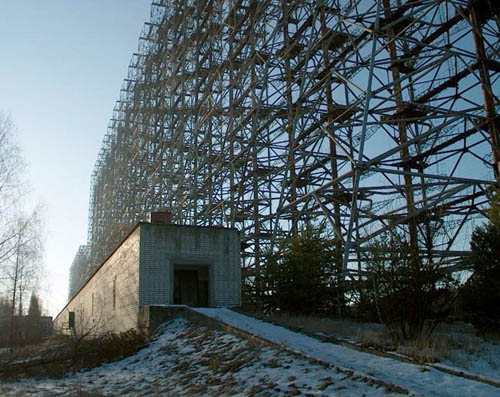
The Russian Woodpecker was a notorious Soviet signal that could be heard on the shortwave radio bands worldwide between July 1976 and December 1989. It sounded like a sharp, repetitive tapping noise, at 10 Hz, giving rise to the "Woodpecker" name. The random frequency hops disrupted legitimate broadcast, amateur radio, utility transmissions, and resulted in thousands of complaints by many countries worldwide.
The signal was long believed to be that of an over-the-horizon radar (OTH) system. This theory was publicly confirmed after the fall of the Soviet Union, and is now known to be the Duga-3 system, part of the Soviet ABM early-warning network.
 One idea amateur radio operators used to combat this interference was to attempt to "jam" the signal by transmitting synchronized unmodulated continuous wave signals, at the same pulse rate as the offending signal. They formed a club called the Woodpecker Hunting Club.
Simple CW pulses didn't appear to have any effect. However, playing back recordings of the woodpecker transmissions sometimes caused the woodpecker transmissions to shift frequency leading to speculation that the receiving stations were able to differentiate between the "signature" waveform of the woodpecker transmissions and a simple pulsed carrier.
As well as disrupting shortwave amateur radio and broadcasting it could sometimes be heard over telephone circuits due to the strength of the signals. This led to a thriving industry of "Woodpecker filters" and noise blankers.
Amateur Soviet Early Warning Jamming Club? That's crazier than outsourcing cyber warfare. You get people involved in something technological, introduce a weird variable like the Woodpecker, and you can get people to create all kinds of narrative to furthering national security. And that was before they even knew how crazy the damn thing looked. If you like that one,
check out these guys, listening to secret Soviet doomed space missions, and turning over their tapes to NASA.
Here's a fictional set-up: a numbers station that is easily decoded, so that conspiracy theories think they are getting the dirt on a conspiracy, when it is disinformation. Or, so that sympathizers follow the decoded orders, thinking that they are operatives, when they are only amateur spies! Fake bomb making recipes in the Anarchist Cookbook! Terrorist provocateurs hiding messages in Flickr feeds!
Or a film about an "implausible" scenario involving a thinking computer and world maps and global thermonuclear war, that encourages distrust in computers for some, and fanatical devotion to esoteric conceptions of reality in others. What could be the goal of this conspiracy? Who thought it up, and how to we counter it? Or should we support it? Whose side are we on?


.jpg)


